
Picture-perfect nature
- pcbaxter
- Oct 16, 2025
- 4 min read
Updated: Oct 24, 2025
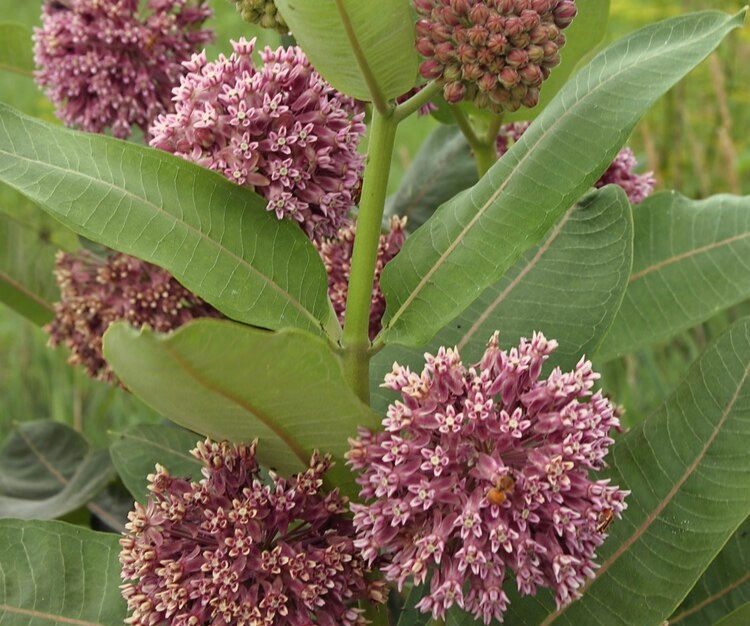
Part 1: The good the bad and the ugly
By the end of summer, Common Milkweed (Asclepias syriaca) is not the most attractive of plants. The once lush, pink flower heads have transformed into big, bleached-out, rough-textured seed pods. Add some insect pests to the fading foliage and the vision plummets even further.
If you take a look at the photo below, you’ll see what I’m talking about. (Fair warning: It’s not a pretty sight.) The red-and-black beetles are the Large Milkweed Bug (Oncopeltus fasciatus). The tiny yellow insects are Oleander Aphids (Aphis nerii), a.k.a. Sweet Pepper Aphid and Milkweed Aphid. Despite the ominous appearance of these clustered insects, both species are fairly benign. They do feed on milkweed leaves but cause little overall damage. Their activity won’t kill the plants.
Harmless creepiness doesn’t creep me out and there can be something fascinating about it, yet of course I’d rather see plants that are whole and undamaged over ones that are infested with insects. Looking at these milkweed plants, I found myself wondering if I truly love nature or whether I just love the pretty parts. Do I unconsciously expect things in nature to delight my eyes, lift my spirits, inspire me? This is why we go to pleasure gardens, right? To see botanical specimens thriving in a way that we probably can’t make happen in our own gardens.
Of course, nature often doesn’t look beautiful. Sometimes it looks like a milkweed plant covered with masses of insects. Stuff dies. Rots. Some alive stuff looks dingy, untended, ungainly. Trees lose leaves, limbs, eventually die. Fungi take over. At the very least, consider the average woodland: beyond the lovely green trees and moss-covered rocks it’s a mess, with downed trees and branches littering the forest floor and years of dead leaves rotting underfoot. Fact is, there’s destruction all around, all the time. And it’s necessary.
I recall an episode from the original Star Trek series titled, “The Mark of Gideon.” In this episode, Captain Kirk is invited to visit a planet where, remarkably, they have achieved a physical state where no one dies. It sounds idyllic, but it’s a nightmare. Without death to balance reproduction, the planet has become so crowded that its inhabitants can barely move. There is no physical freedom. No joy. The planet desperately needs death, and we eventually learn that that Kirk has been brought there to introduce disease.
At a place like Longwood Gardens, not far from where we live and ranked as one of the premier gardens in the world, staff and volunteers work diligently to remove dead blossoms and plants that aren’t doing well, so that everything looks perfect. That makes it easy to think that we should be able to get the same results in our own gardens, that this is the way nature is supposed to look.
But what, really, is “perfect?” The way nature’s been doing things has worked for millions of years. How does our view of perfection influence how we interact with the world around us? Does it help to remember that everything ultimately gets recycled and reused?

Part II: “Which story do you prefer?”

On a beautiful, sunny day earlier this October, Charlie and I set off for a walk on our favorite stretch of the French Creek trail. The first part of it runs along a National Guard facility that sits off-limits behind chain-link fencing topped with barbed wire. A clump of tall, yellow-flowering plants growing inside the corner of the fencing caught my eye. “Oh, wow!” I pointed. “I just read about Tall Goldenrod a few days ago and here it is!”
“Maybe you should take a photo,” Charlie offered. He knows from experience that I take photos of everything: plants mostly, but also sunsets and reflections. Dead stuff. My photo library contains plenty of images of deceased birds, snakes, frogs, bees, dragonflies, and more.
“Uh-uh,” I said, “The fencing is in the way.” And then I laughed at myself.
I laughed because I realized that when I take a photo of something to share in my newsletter or on social media, I do the very thing that I talked about in Part 1 of this post: I try to perfect the image, make it look beautiful. I crop out stuff I don’t want, like buildings, cars, and power lines. I look for the best angle, the most favorable light. At home, I turn or tilt the camera to avoid capturing anything that would show flaws in my own garden. It would be easy for people to imagine that I live in a paradise. (Which I feel I do, but that would be a separate story.)

With each of these posts I've presented two photos, one that is beautiful and one that is not. As the protagonist in The Life of Pi asks at the end of the novel, I want to know: “Which story do you prefer?” In Part 1, do you prefer the image of the milkweed flowers or the image of the seed pod covered with insects? In Part 2, do you prefer the photo the Tall Goldenrod growing free or the one where they're confined within manmade fencing, eking out a rough existence? If I had led with either the insects or the fencing photos, would you have wanted to read on or would you have clicked away?
These are not idle questions; I’d seriously like to know your thoughts.


Pam, what interesting concepts to think about the contrast of beauty/ugly (eyes of the beholder). It reminds me of a dear friend who said once that she dislikes a flower that doesn't show decay (i can't remember which flower she referred to) but that concept has stayed with me, that beauty fades and it's all natural.